Alabama Archaeological Society

Pay your dues or send a donation to AAS (a non-profit organization) online! Go to Dues & Donations for instructions for this simple and quick way to be a part of archaeology in Alabama.

Check us out on FACEBOOK!

This most recent issue of Stones and Bones is available for free right here! Join AAS and receive great issues like this one at home. Click Here for a free copy of Stones and Bones!

Here is an excellent article from Alabama Heritage, Winter 2011, Issue 99,  about Alabama's Archaeological Sites and How important they are Click Here

Here is a free photography scale for taking pictures of artifacts, open in mspaint, and be sure your printer settings are set to 100% Free Photo Scale!

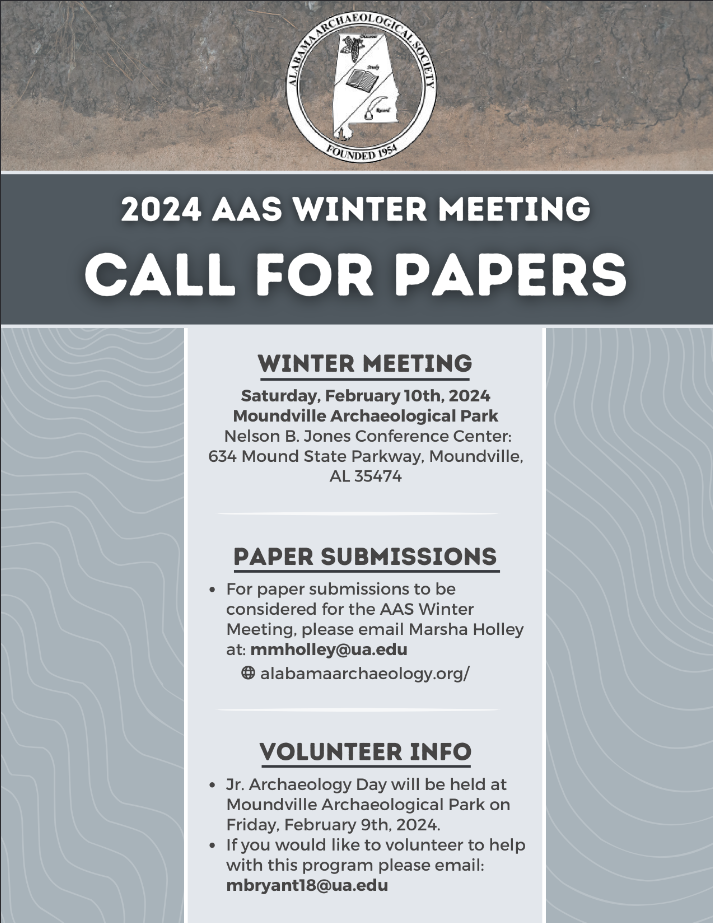
Upcoming Archaeology Events in Alabama

The 2013 Summer Meeting of the Alabama Archaeological Society will be held June 29, 2013 at Oakville Indian Mounds in Danville, Alabama.  Registration is $4 for Society members and $5 for non-members, with no charge for children under 12. The program will include a few speakers and presentations about the history and archaeology of the park and the local area in the morning, with a walking tour of the park and other sites after lunch. In the event of extreme weather it will be a driving tour. If you have artifacts you would like to learn more about, the various members in attendance could likely shed some light on them for you. Park information can be found at http://www.oakvilleindianmounds.com/ Lunch will be a typical southern picnic with a charge of $5 to offset cost, or you may bring your own lunch or drive to a nearby town on your own.


Archaeology Job Announcement

We’re looking to hire an “Interpreter of Archaeology” at Old Cahawba ASAP. Job would involve working with the public mostly, so has to be a “people person.”   Closing date for applications is March 6th!  The classification in the state system would be “Archaeologist, Historic Sites Option.” http://personnel.alabama.gov/Documents/Announcements/101554_A.pdf

 The State of Florida Arrests Several for Stealing and Selling Artifacts, read the full story here.

 Florida protects its archaeological sites and artifacts, on the ground and underwater. Let's hope Alabama continues to do the same!
http://madisonfloridavoice.net/?p=32970

Here is a slide show of some of the destroyed sites and recovered artifacts, many of which were dredged from Florida state waters: Note the damage that occurred at some of the locations.  http://www.flickr.com/photos/myfwcmedia/sets/72157632872560173


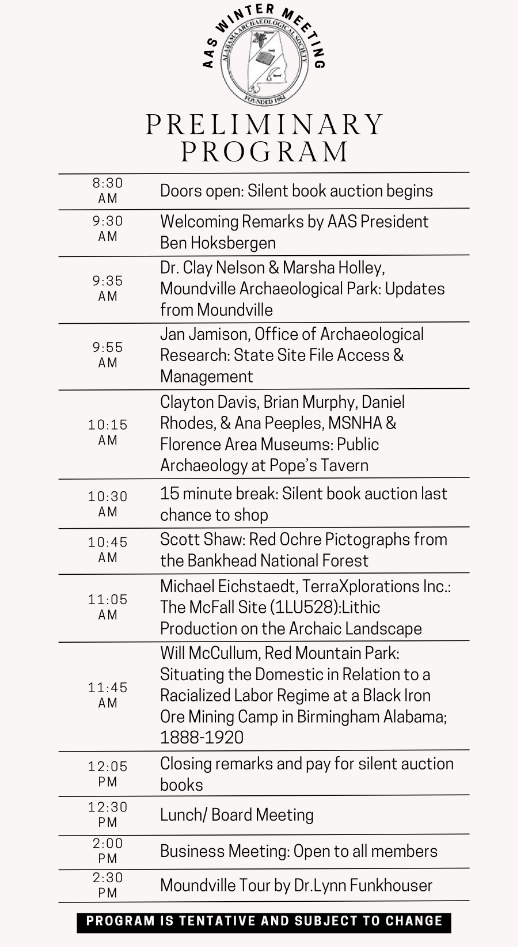
The 2013 AAS Winter Meeting

             Over 70 AAS members and guests enjoyed the evening reception at the Delchamps Archaeology Building and Museum Friday nite and on Saturday, the presentations illuminating the new research of Alabama’s prehistory and history.  Our hosts, the University of South Alabama (USA) Center for Archaeological Studies (CAS) staff, the Archaeology Museum staff and the AAS Southwest Chapter (Mobile) are to be commended for a wonderful meeting.  Not to be forgotten are the sponsors of our meeting who graciously donated funds to subsidize our meeting: MRS Consultants (Tuscaloosa), Brockington & Associates (Norcross, GA), Wiregrass Archaeology (Dothan/Mobile), Panamerican Consultants (Tuscaloosa), Tennessee Valley Archaeological Research (Huntsville), Southern Research Historic Preservation Consultants (Waverly Hall, GA), New South Associates (Stone Mountain, GA), and the Southwest and the East Alabama chapters of AAS.  We had plenty of food and drinks Friday and Saturday during and after the meeting – more than enough, really!

            Saturday’s presentations began with Dr. Kristrina Shuler (Auburn), who discussed her study of skeletal material that focused on the stress markers found at the junction of ligaments/tendons/muscles and bone in “Upper Limb Entheseal Change with the Transition to Agriculture in the Southeastern United States: A View from Moundville and the Central Tombigbee River Valley.”  Next, Tara Potts (CAS) discussed how the analysis of maps and subsequent testing of potential locations resulted in the discovery of an important Creek War town with “Holy Ground: A Historic Creek Village and Battlefield.” This virtually undisturbed historic site has since been purchased by the Archaeological Conservancy for preservation.  Teresa Paglione (USDA NRCS) gave an overview of how volunteers have been used to research and map sites in “NRCS and AAS Volunteer activities: Riverview, Jimmerson and MT 99.”  Dr. Phil Carr (USA) described stone beads and their production in "The Organization of Prehistoric Chert Bead Technology." He showed examples of chipped, ground and drilled stone beads and the tools used to make them.  Before the first morning break, we heard from Kassandra Williams, a Troy student, regarding several surveys and sites adjacent to wetlands in  “Soggy Sites: Surveys of Selected Wetland Reserve Program Lands.”

            After the break, Hamilton Bryant (Auburn) gave an overview of the newest discoveries at a site that has been intermittently tested by university fieldschools over the last decade with “Trenches, Remote Sensing and Soil Cores: Investigations at the Ebert Canebrake.”  The site includes several structures as well as a palisade wall clearly visible via remote sensing. We then had a bit of a different topic just over the state line with the discussion of an underwater site by Rebecca Booker (U West FL). “Life in a Floating Lumber Camp: An Archaeological Survey of a Submerged Site on the Escambia River” was a unique look at the structural remains (and aerial features) of an industry that involved removing cypress logs in wetlands and swamps. Returning to a more familiar subject, Scott Butler (Brockington and Associates) discussed “Prehistoric Site Distributions in West Central Alabama-Results of the 2011 Survey of the I-85 Extension Corridor.”  After Scott, we were treated to an in-depth look by Ned Jenkins (AL Historical Comm./Ft. Toulouse) at a favorite subject – “where de Soto slept” – aptly entitled “The Hernando deSoto Entrada through Central Alabama: September-November, 1540.” Ned discussed following – or rather recognizing the clues to locating the specific trails and sites de Soto and his troops visited.

            After lunch we convened our Business meeting, which included reports by our treasurer and publications editors as well as elections.   We also announced the recipient of the Mahan Research Award.  Representing the Huntsville Chapter, Ben Hoksbergen accepted the $500 grant, which will be used for a C-14 date.  The winner of the $500 AAS scholarship was Rachel Briggs, a doctoral student at the University of Alabama. (We did not receive any applications for the undergraduate scholarship.)

            Following the election, presentations resumed with Dr. Ashley Dumas (UWA) presented "Updates on the Fort Tombecbe Archaeological Project" which included finding the French walls, bread ovens, a “Public Archaeology” event on National Archaeology Day (October 20) and an opportune visit by Alabama’s US Senator Jeff Sessions, whose departure was delayed by a rainstorm – thus allowing more time to see Alabama history first-hand and talk to the archeologists about the interpretations of the artifacts and features in context.  Ben Hoksbergen (Redstone Arsenal) described how sites and features discovered eroding from the riverbank were investigated with "Water, Time, Gravity...Money:  Salvaging Archaeological Data on the Tennessee River Bank along Redstone Arsenal."  Our next speaker, Jeremy Davis, PhD candidate at Alabama, gave us an update on what has been found by remote sensing and testing at Moundville just since our summer meeting- with “On Common Ground: Memory, Identity, and the Remaking of Communal Tradition at Early Moundville.” The results of a ground penetrating radar survey together with limited testing has enabled the interpretation of different types of magnetic anomalies which should result in a map of Moundville depicting its buried structures. Next was another Auburn graduate student, Kelly Ervin, who presented an analysis of the shellfish recovered on sites with “Woodland Exploitation of Freshwater Mollusk in the Upper Alabama Drainage.”  The bivalve species were identified to better understand the mid-late Woodland subsistence strategy and the environments where such shellfish thrived – or used to thrive since some are now extinct due to the construction of dams, sedimentation and slow-moving, warmer waters. Finally, we returned to Moundville for Brandon Thompson’s (UA Office of Archaeological Research/Moundville) “Preliminary Results of the 2012 Mound P Flank Excavations.” The excavations are necessary prior to the construction of a ramp and viewing platform from the museum to the mound.

            The Friday evening reception (6-8pm) allowed everyone time to visit the museum and to chat with other AAS members and the general public in a leisure atmosphere -without having to worry about missing presentations or a long drive home in the dark.  Saturday was a full day of presentations – but we still had time to return to the museum for snacks and drinks for an hour or more before everyone had safe drives home to Pensacola, Mobile, Birmingham, Florence, Eufaula, Opelika, Huntsville, Tuscaloosa, Selma, Montgomery . . . .   If you missed the meeting --- you missed a really good one!

 submitted by: Teresa Paglione

Figuring out things that come to the Alabama Archaeological Society

About once every two or three months, it is not unusual for me to receive emails from people trying to identify an artifact or two - or more. Usually I relay a little information about the artifact type, its age and where they might find more information. Occasionally, someone brings an artifact or a frame with projectile points or even a bucket of artifacts to an AAS chapter meeting. Last summer, when I presented a PowerPoint-aided lecture on the use of remote sensing in archaeology to the Cullman Chapter of AAS, Robbie Camp, the chapter president, showed me an engraved palette in his possession. As told to him, the palette was found in a garden bed in the Dothan area of southeast Alabama.
Upon first look the palette – real or not - is fairly impressive. The stone is a ¼ inch thick and is 9 inches by almost 12 inches in size with an engraved or repeatedly scored design that measures 6.5 to 7.5 inches in diameter. The design, however, is not typical of the palette designs or vessel decorations seen in southeastern prehistory; it resembles one of those Celtic knots famous for the interlaced patterns. The actual scoring or engraving of the interlocking design is a little irregular – in some places it is deep and thick and in others it is very thin and shallow – but that might be expected from an unfinished product. In addition, the rock itself appears to be a lamellar or layered (sedimentary) shale or siltstone -- or very weathered limestone – also not typically used as a palette. Although ‘Robbie’s Palette’ is impressive, we were pretty sure it was not authentic – that is, not prehistoric or Native American-made, but I wanted to get do some research and more expert opinions since I haven’t had much personal experience with this particular artifact type.
A check of the archaeological literature reveals that although palettes have been found throughout the southeast during the Mississippian period most of them appear to have come from either Moundville or Etowah. (The Mississippian period occurs as early as 850AD to as late as 1700AD – depending on the location; in Alabama, we normally refer to it as 1000-1450AD). The palettes from Moundville have been well described by CB Moore in 1905 and 1907 and as recently as 2009 by Jim Knight (Univ. of Alabama). The palettes of Etowah were the subject of a recent article in American Antiquity, the journal of the Society for American Archaeology (Steponaitis and others 2011). (Incidentally - probably the most famous palette is the Rattlesnake Disc - the State Artifact of Alabama.)
The palettes of Moundville and Etowah are both similar in size and shape with common decorative themes found in Mississippian art. Both appear to be locally made - that is, the material used was common to the Moundville or Etowah general region. When these palettes were first described in the late nineteenth century, they were believed to be plates for holding food or calendars for marking time. In 1905, CB Moore however, suggested their use as palettes for mixing paint. That interpretation still holds today. Residue from colorful minerals has been found on many palettes, suggesting a functional use – not as a mortar for grinding mineral but to hold the minerals or ‘paint’. Their function was perhaps spiritual and symbolic – used in rituals or ceremonies.
I also emailed photographs of Robbie’s Palette to several other archaeologists in Alabama. Everyone agreed the design was certainly not one that resembled palettes that had been previously found. The best clue was offered by Hunter Johnson (Tennessee Valley Archaeological Research, Huntsville). While at the University of Alabama, Hunter worked on a palette manufacturing site in Tuscaloosa that contained masses of broken palettes, palette fragments, and sandstone debris; he noted that he had never encountered a palette with the interior design completed before the exterior portion or rim of the palette was finished…. Robbie’s Palette has a finished interior (the engraved interlocking design) but the rock itself is not ground or polished to a finished edge.
In addition, I also asked a geologist and a soil scientist to examine the palette material itself since it didn’t appear to be sandstone to me. Both indicated it was clearly not sandstone or limestone but mudstone. Mudstone is frequently encountered in early clay deposits that have been exposed along eroded creekbanks. It is a general term that includes claystone, siltstone,
shale and argillite. It is significantly softer than sandstone and thus much easier to score or engrave.
So . . . It seems to be the consensus among several Alabama archaeologists that ‘Robbie’s Palette’ is not of prehistoric origin or use. There are just too many red flags to point to this particular palette as an authentic Mississippian period artifact:
(1) The shape is not typical of southeastern palettes;
(2) The engraved design is not typical;
(3) The material itself was not typically used in the manufacture of palettes; and,
(4) The edges have no definite shape and yet there is already an interior design (although it is not completely finished or polished).
That being said, it is a nice piece of artwork well worth the $25 that Mr. Camp paid. Plus, now it offers Robbie Camp and me an opportunity to discuss a curious and unusual artifact as well as discuss its “authenticity” as a Native American Indian artifact.
Teresa Paglione
(This is a slightly modified reprint of a 2012 Stones and Bones AAS newsletter article.)
References:
2013 Personal Communications, Greg Brannon and Bill Smith.
2012 US Geological Survey. http://tin.er.usgs.gov/geology/state/sgmc-lith.php?code=2.1.1
2011 VP Steponaitis, SE Swanson, G Wheeler and PB Drooker, “The Provenance and Use of Etowah Palettes,” American Antiquity 76(1), pp 81-106.
2009 VJ Knight and VP Steponaitis, “A Redefinition of the Hemphill Style in Mississippian Art” In Visualizing the Sacred: Cosmic Visions, Regionalism and the Art of the Mississippian World, edited by GE Lankford and others. University of Texas Press.
1905 CB Moore. Certain Aboriginal Remains of the Black Warrior River. Journal of the Academy of Natural Sciences of Philadelphia. (Also available in edited versions from Univ. of Alabama Press www.uapress.ua.edu/product/Moundville-Expeditions-of-Clarence-Bloomfield-Moor,832.aspx and Capitol Book and News www.capitolbook.com/Clarence_Moore.htm).


View a large version of this artifact here. palettelarge.jpg


Here are some Weblinks to current ongoing excavations in Alabama

http://www.museumoftheblackbelt.blogspot.com/ - Fort Tombecbe excavations, an early French Fort on the Tombigbee river.

http://moundvilleplazaproject.wordpress.com/ -Current work being conducted at Moundville using remote sensing techniques.

http://pensacolacolonialfrontiers.blogspot.com/ - Spanish site in Florida just south of Atmore (Mission San Joseph de Escambe, 1741-1761)

http://freetravelwithus.com/Alabama/Moundville/Moundville_Page.htm a great video about Moundville can be found here.


New Website and Organization to Help Protect Alabama's History

The Coalition to Protect Alabama’s History (C-PAH) is a non-partisan, grassroots organization dedicated to protecting Alabama’s irreplaceable cultural heritage. C-PAH's primary mission is to educate citizens and lawmakers about the importance of preserving the unique remains of Alabama’s history found in its archaeological sites, both on land and underwater.  Check out the website at http://www.c-pah.org/

This letter was received by the president of AAS, Teresa Paglione, and other members of AAS and AHA. AAS also urges our legislators not to forget to fund our historic and cultural agencies throughout the state.  Rather than repeat what is in Dr. Olliff's letter, it is presented here in full.  Even though this posting is a little late to influence this year's legislation, we can start now by reminding our 2012-2013 representatives that we are paying
attention to their actions it comes to Alabama heritage!

Alabama Historical Association
April 17, 2012

At the 2012 Alabama Historical Association Business Meeting, Dr. Ed Bridges asked us to act in the interest of Alabama History by urging our legislators to not starve historical and cultural agencies in the state.  As you know,
Governor Bentley's General Fund Budget severely reduced or eliminated funding for many such agencies, though the savings are not significant.  The House has passed a version of that budget, threatening to leave a number of state agencies adrift.

Certainly we can debate the role of government and the shortfall in the General Fund.  But if the state starves these historical agencies, they will die and not return when times get better.  State agencies cannot run on the
kindness of private contributions, and they are not commercial enterprises that can sell a product or service.  We might offer the AHA as a counter-example, but it took since 1947 to build the current AHA infrastructure and without the significant-and hidden-contributions of state agencies (particularly universities) the AHA would be unable to provide more than a short annual business meeting.  A state agency cannot operate this
way; the people would not allow it, and rightly so.

So please contact your legislators.  Ask them to support Alabama History by restoring funding or finding alternative funding for those agencies that have seen their appropriations stripped or eliminated.

You can find contact information for your Representatives here:
http://www.legislature.state.al.us/house/representatives/houseroster_alpha.h
tml


And for your Senators here:
http://www.legislature.state.al.us/senate/senators/senateroster_alpha.html

Marty Olliff, President 2012-2013
Alabama Historical Association


Check Back Soon for Information about Upcoming Digs and Public Archaeology Activities


Archaeology in the News:

Influential Archaeologist Rathje Passes Away

William L. Rathje, a professor emeritus at the University of Arizona who pioneered the study of modern refuse as a scientific discipline, died at his home in Tucson, Ariz., on May 24. Officials said Rathje, 66, died of natural causes. Services have not been announced. Four decades ago, Rathje, then an up-and-coming young archaeologist and already noted for his work on ancient Mesoamerican civilizations, thought that the principles and methods of archaeology could also be used to extract information about contemporary behavior in society changes over time.  http://uanews.org/node/47560 

 After Four Centuries, Portuguese return to  Central Alabama

Selma Rotarians recently welcomed a Portuguese exchange group of five women which included a 27 year-old archaeologist Raquel Henriques (with green scarf in center of photo ) 

Pictured in photo:  Selma Rotarians in back, Altson Fitts and John Nettles -   L to R, Sofia Martins;  Linda Derry, site director;  Maria Jose Rodriques;  Maria Paula Cortes Tavares  and Ana Margarida Gomes .

Raquel’s one wish  for her visit to Selma was to visit the Old Cahawba Archaeological Park,  and her enthusiasm pulled her travel companions along for a special presentation and tour.    In an attempt to make Alabama’s history relevant to these special guests, Linda Derry,  the site director, mentioned the many Portuguese that accompanied Hernando de Soto on his historic trek through central Alabama.  When shown a list of  the Portuguese  that reportedly joined the expedition, these modern visitors noted that they were  very familiar with all the family names.    In addition, one of these visitors  was a  cork farmer from Elvas   -  as in the Chronicle of the Gentleman of Elvas ,  which is an account of the trek published in 1557 in Portuguese.  Many American archaeologists in the search for sites associated with the expedition have used a translation of this account.  

In the visitor center, the women considered a replica of a 16th century helmet, explaining to the park staff why this would have been Spanish rather than Portuguese.      Before the group left Old Cahawba, Linda encouraged archaeologist and historian Raquel Henriques to hunt for yet undiscovered documents about this great historical event in Alabama’s history when she returned home;   Raquel, in response, discussed the many archives in her country that might contain relevant  historic documents.   The women plan to visit Fort Morgan later this spring before returning home to Portugal.

 Linda Derry, Site Director

Old Cahawba

719 Tremont St.

Selma, AL 36701

Archaeological Community Protests Looting as Televised Entertainment Programs

  • Archaeologists are mounting a campaign against two new cable TV shows that they say encourage and glamorize looting of American archaeological sites. On 20 March, Spike TV will premiere a new show called American Digger, while a show called Diggers on the National Geographic Channel made its debut 28 February. Both shows "promote and glorify the looting and destruction of archaeological sites," Society for American Archaeology (SAA) President William F. Limp wrote in a message posted earlier this week to the SAA listserv. http://news.sciencemag.org/scienceinsider/2012/03/archaeologists-protest-glamorizan.html

    Response to Looting Television from Archaeology Southwest

    The story of our shared past is best told not by individual objects, but through the understanding that comes from examining these objects in the context of their specific find locations, their relationship to surrounding objects and built environments, and their meaning within a much larger physical and cultural landscape. We believe that removing any ancient or historical object from its resting place must be a carefully considered act-even among archaeologists-and not one done for personal gain or private ownership. The past is not owned; it is shared. http://www.archaeologysouthwest.org/2012/03/01/statement/

    Response to Looting Television from the Society for American Archaeology

    SAA and other groups, such as SHA, have already prepared and sent strong letters condemning both of these programs to the production companies, networks, and others. Copies of the SAA letters can be found on the SAA website (http://bit.ly/w2MHJM  and http://bit.ly/wzT7IA ). The letters provide details on why we are so concerned. Up to this point Spike TV has not responded to the public outcry. Leadership of National Geographic, however, has indicated that, while they are unable to stop the showing tomorrow on such short notice, they will place a disclaimer into the show that speaks to laws protecting archaeological and historic sites. They are also willing to enter into discussions with the archaeological community to determine how to raise awareness of the impacts of the use of metal detectors for treasure hunting.

    Response to Looting TV from the Archaeological Institute of America Elizabeth Bartman, AIA President, sent letters to executives at National Geographic and Spike TV to express concern over the content of two new TV shows-Diggers (National Geographic) and American Digger (Spike TV)-that promote treasure-hunting and the unethical digging of archaeological sites. Below are the letters that were sent to the two organizations.  http://www.archaeological.org/news/aianews/8256


  • AAS Field Trip in Monroeville News Story Steven Meredith with the Alabama Archaeological Society and members from across the state set up a grid on the property in central Monroe County, and sifted soil dug from each section unit of the grid to find artifacts. Full Story Here!
  • Students in Macon County bring Artifacts to Light SHORTER -- University of Vermont student Eric Schlosser last week was digging at the site of a Native American village occupied about 700 to 800 years ago when he heard a "tink" sound, the sound of his metal trowel hitting ceramic.He said he slowly dug around the object, found about 20 inches below ground level, and then gently scrapped dirt from a piece of pottery about two inches long and wide, apparently broken from a larger object. Curved lines adorned a brown surface."It is so exciting," Schlosser said. "You're holding something that somebody put a lot of effort into making, which is pretty neat." The pottery dates from about 1250 to 1300 A.D., estimated University of Vermont anthropology professor Cameron Wesson. http://blog.al.com/spotnews/2011/06/students_in_macon_county_bring.html
  • Congratulations to Linda Derry!  Our own Linda Derry was picked from over a hundred other archeologists nominated for a "spotlight" in non-academic "Careers in Archaeology."  Check out "Grassroots and Boots: A Career in Community-Based Archaeology in Alabama's Tall Grass" on page 19 of the "SAA Archaeological Record" (Publications on SAA home page)at http://onlinedigeditions.com/publication/?i=65152&p=21 or click on the attached pdf: SAA Record- LDERRY."

  • The September AAS dig at the Upper Salt Works. Over 30 AAS members participated on September 18 and 19 at the AAS excavation field trip to the Upper Salt Works. On both days we excavated an area of the site occupied in the Early Paleoindian (Clovis), Middle Archaic, and Late Woodland periods. On Sunday we continued excavations on the prehistoric components while some of us worked on excavation units in the ruins of a Civil War salt furnace. Thanks to Ashley Dumas and Steven Meredith for organizing this trip. The artifacts and records will be curated in the University of West Alabama. The dig was part of ongoing research on Salt production in Southwest Alabama and Paleoindian settlement in the Gulf Coastal Plain. See a video of the dig on YouTube.
  • Guidelines for authors for the Journal of Alabama Archaeology. The Journal of Alabama Archaeology remains the primary forum for the publication of papers on the prehistoric and historic archaeology of Alabama, however papers on related topics in the Southeast are welcome. Papers from students, amateur, and professional archaeologists are solicited. The guidelines and style guide for authors, a PDF file, is available to download.
  • AAS is on Facebook! Look for the Alabama Archaeological Society on Facebook and become a fan!
  •